
The Context
Peak season doesn’t have to end in January. For one retail company, two consecutive years of using Postie’s CRM Optimization engine show consistent performance that is hard to ignore.
In the 2024–2025 holiday season, the retail brand used Postie to run a controlled test pitting standard CRM sends (the baseline) against CRM Optimization. This approach kept incrementality as the focus by targeting the highest-value, most-responsive segments within a brand’s existing list.
One year later, we repeated the strategy. Same methodology. Same measurement window. Same performance comparison structure.
The discovery? Consistent results.
The Findings
The two consecutive seasons showed consistent results:
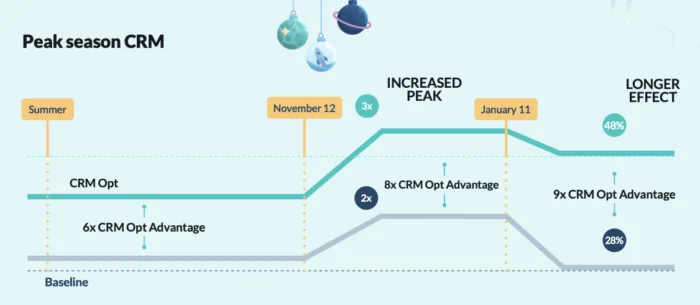
- Baseline peaked at approximately 2x above pre-peak levels.
- CRM Optimization reached almost 3x at the holiday peak, an 8x advantage over baseline at the inflection window.
- Post-peak (mid-January), the CRM Optimization advantage held at 9x over baseline.
- Post-peak retention for CRM Optimization was approximately 48%, in line with the prior year’s result.
- The extended momentum carried into the new year was once again visible and measurable, with the performance gap actually widening as the baseline decayed faster.
The Meaning
Most brands optimize for the November-December spike. They pour budget into creative, increase send frequency, and measure success by holiday revenue. What they miss is the slope of the decay curve, or how fast performance drops after December 25.
CRM Optimization attacks that decay directly. By focusing on incrementally responsive audiences rather than the full list, it builds a more durable performance base that doesn’t collapse the moment the holiday urgency fades.
In January of both seasons, the gap between baseline and CRM Optimization was actually wider than at peak. Baseline had dropped sharply; CRM Optimization had not.
Brands using CRM Optimization weren’t just winning during the holidays. They were extending their competitive advantage into Q1, a window most competitors had already abandoned.
The advantage doesn’t just hold, it widens.
This is the compounding effect of incrementality-focused marketing: the longer you run it, the more it separates from the baseline. CRM Optimization isn’t a seasonal tactic. It’s a structural advantage that compounds over time, extends performance into the calendar’s weakest window, and creates a measurable gap between brands who use it and those who don’t.
Strategy Recommendations
-
1
Shift 50% or more of your CRM campaigns into CRM Optimization during peak season windows, on a 30-45 day cadence.
-
2
The November-January window is the measurement frame. But when the setup begins in October, the payoff extends through February.
-
3
See the true incrementality of your optimization efforts through a holdout test with a controlled baseline to measure against.